The Operational AI Stack: Why AI-Guided Workflows Define the Next Layer

Updated: May 20

Many organisations I speak to have already experimented with workflow automation.
They launch RPA programmes, automate a handful of processes, and see real gains in specific areas. But they also run into familiar limits: rule-based automations that needed frequent maintenance, that struggled when conditions changed, and became harder to scale over time.
They might then conclude that automation has reached its limit, while others keep extending their RPA estate, trying to make it support work it wasn’t designed to handle.
For organisations that never got that far, the problem may look different, but the conclusion is often similar. While automation has been tried - informally or formally, it’s been done without consideration of the surrounding structure needed to make it durable.
I’ve seen this experience shape how leaders think about this Automate layer of the Operational AI Stack. And in many cases, it leads them to underestimate what has changed.
AI-guided workflows are not RPA. This is a distinction that matters more than it might appear, and the reason why this layer deserves a second look from leaders who feel they have already been here.
Where the Assist Layer Stops
The previous article in this series identified the limits of the Assist layer in the Operational AI Stack: while it improves how people interact with work, it doesn't change how work moves.
Yes, copilots are in place, knowledge is more accessible, and decisions are better supported.
We’ve seen the friction of navigating systems reduce. But often the operations themselves haven't changed - requests still move through inboxes, approvals still happen in chat threads, and handoffs still depend on someone remembering to act.
This isn’t a tools problem. It's a structural one. And it's the gap the Automate layer is designed to close.
Assist to Agentic via Automate - The Essential Middle Layer
There’s a consistent pattern. Organisations deploying AI at the Assist layer are looking ahead and want agentic AI. Autonomous systems. Agents acting across platforms and optimising outcomes end-to-end.
While the ambition is right, the sequencing isn't.
Agentic AI needs defined processes to act within, consistent logic to apply, and structured handoffs to execute. Without that foundation, autonomy doesn't deliver value, instead it amplifies any inconsistencies already there.
So the Automate layer shouldn’t be seen as a stepping stone to Agentic; it's the prerequisite.
What AI-Guided Workflows Actually Are
This is where prior experience, whether with RPA or with informal attempts to impose structure, often stands in the way of clear thinking.
Rules-based automation executes fixed sequences; it follows a defined path and breaks when conditions change, requiring constant maintenance as processes evolve. This ceiling is real, and most organisations aiming for structured automation, in whatever form, have found it.
AI-guided workflows operate differently. They interpret context, adapt routing based on live data, and handle variation that would stall a rules-based system. A request with a missing field or an unexpected condition can be classified, rerouted, and resolved by a workflow that understands what the process is trying to achieve.
The failures so many organisations experienced were not caused by the ceiling of automation, but by applying fixed logic to work that wasn’t sufficiently defined. This is a design problem, not a technology one.
What Changes When the Structure Is There
Take a service request or incident in IT support. Under current conditions: a request arrives, someone reads it, works out what it needs, forwards it to the right team, chases for updates, and eventually closes the loop. Each step depends on a person knowing what to do and having time to do it.
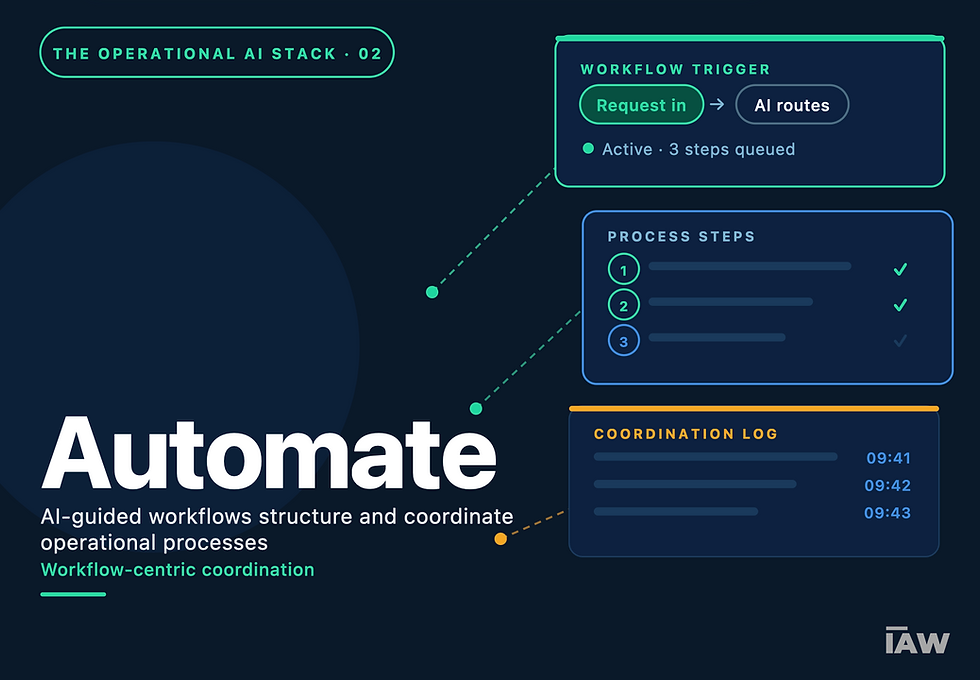
An AI-guided workflow handles the coordination. The request triggers the workflow. The workflow classifies it, routes it to the correct team or system, enforces the process steps in sequence, escalates if a step stalls, and maintains a full log throughout.
Humans are still needed where judgment matters. A decision requiring context, consequence, or relationship stays with the individual. But everything between those decisions is handled by the system.
Here, the outcome isn't only speed, it's consistency. Every request follows the same path, meaning the operation becomes something you can observe and improve, rather than something you can only describe after the fact. And the leader asking where something is gets an answer from a system, not someone's best recollection at that moment.
The Problem With Knowledge That Lives in People
In most organisations, operational knowledge lives in people. The process logic, the exception handling, the escalation judgement: these are things experienced staff carry and apply.
The biggest issue with that is that it works until it doesn't. A key person moves on. A process that ran reliably for three years starts producing inconsistent outcomes. Six months later, someone realises that the knowledge has left with the individual, and by then the damage is already done.
That's not a training problem. More training doesn't make knowledge durable. It just slows the rate at which it walks out of the door.
What makes this harder is that it is rarely accidental. Knowledge is perceived as power. Those in your organisation who understand the exceptions and which cases need to be handled differently have status because of it. Asking them to build that into a system can feel like being asked to give something away.
That instinct is rational, and leaders who ignore it will find workflow design stalls long before the technology does.
The question isn't how to persuade people to share what they know. It's about creating conditions where doing so feels safe and is properly rewarded. It's a leadership decision, not a change management programme.
AI-guided workflows change the structural side of this with process logic, business rules, and decision criteria encoded into execution: available to everyone, independent of who is in the team on any given day. The knowledge becomes part of how the organisation operates, not dependent on who happens to be in it.
What Coordination Actually Looks Like
The Automate layer is sometimes described as automation, but a more precise term is workflow-centric coordination. It’s the structured movement of work across systems, teams, and decisions, with every step sequenced, logged, and visible.
That last word is key for anyone operating at scale. When work moves through people, visibility is crucial. You ask someone where a case is, they tell you what they remember, and you act on that.
When work moves through a coordinated workflow, visibility is a record. Every step has a timestamp. Every handoff is logged. Every stall is surfaced before it becomes an escalation.
You can see, then, why this makes the Automate layer the foundation for everything that follows, not just operationally but also in terms of governance. You can’t be sure of what you can’t see.
And, before this layer is in place, most organisations genuinely cannot see how their work is moving.
This layer has its own ceiling. Workflow-centric coordination structures the process, but it doesn't optimise it. The routing logic defined at build time will eventually meet conditions it wasn't designed for.
The Foundation for Agentic AI
The Agentic layer, which we’ll cover in the next article of the series, introduces autonomous AI agents that execute and optimise outcomes across systems simultaneously: ITSM, ESM, CRM, ERP, analytics, and communications. That’s tasks running in parallel, and outcomes tracked and measured in real time.
This only becomes viable when the operations underneath it are structured. Agents need processes they can act within, logic they can apply, and handoffs they can execute without a human bridging the gap.
Organisations that skip this layer don't achieve autonomy faster; they find themselves with a more expensive version of the same coordination problem, running at greater speed and with less tolerance for the gaps that people are currently papering over. Because the gaps don't disappear when you add agents, they just stop being deniable.
Defining how digital services and AI-enabled workflows operate, perform, and scale.