How to Develop AI-Driven Hyperautomation for Business Growth: A Maturity Guide to Smart Efficiency

Updated: Mar 29

As leaders within our organisations, we’re always looking for new ways to improve efficiency. Automation has been promising us such improvements for years by reducing manual effort and improving consistency, but as technology evolves, so does the ambition.
What Is AI-Driven Hyperautomation?
With the opportunities that come from automation, machine learning, and AI, the new goal isn’t just to automate tasks; it’s to create intelligent, adaptive systems that can discern, assess, and act on their own. This is the essence of AI-driven hyperautomation.
By bringing together automation, AI, and data, you can enhance efficiency to deliver better experiences at scale. But hyperautomation isn’t a switch you can flick or an app you can install; it’s a path of maturity. Moving from simple, rule-based automation to intelligent autonomy is a process and one that I want to explore with you here.
Hyperautomation Maturity: From Automation to Autonomy
Developing hyperautomation in your organisation is a journey, one that requires a clear understanding of your current situation and needs, as well as a solid plan. In this article, I’m going to outline the three stages from automation to autonomy, steps that will transform any organisation.
1. Automate - From Repetition to Reliability
The hyperautomation journey begins with automation.
For most organisations, this work will focus on streamlining routine, repetitive work - examples might include approvals, notifications, data entry, or report generation. Common use cases include invoice processing, user access requests, compliance reporting, and data synchronisation across systems. These processes follow clear, rule-based logic - “if this, then that” - and give organisations a way to bring consistency and control to high-volume operations.
This is the foundation of digital efficiency. At this stage, your automation increases processing speeds and reduces human error. But, while this is effective, it’s still reactive; these systems are executing what they’re told, nothing more.
Automation gets work done efficiently and effectively, but without the next steps, it has no capacity to learn or react.
2. Assist - From Implementation to Intelligence
The next stage adds intelligence through digital assistants, systems that don’t just follow instructions, but understand context.
Using natural language, predictive analytics, and pattern recognition, these AI-driven assistants guide decision-making, becoming collaborators rather than tools. Processing your data, digital assistants will use your given rules and prompts to guide, suggest, and learn from interactions.
So, where earlier automation replaced repetition, AI assistance can now support human judgment.
By bringing clarity to our data, recognising patterns, and exploring complex scenarios through predictive analysis, these digital assistants offer our people the opportunity to focus on the things machines can’t replicate: creativity, problem-solving, and empathy.
What these systems offer is the virtual support of a colleague who can interpret customer sentiment, identify relevant insights, or draft content in seconds. For example, an assistant might summarise service trends, flag emerging risks, or recommend next-best actions based on live operational data.
It’s automation that learns, and adapts — not just executes.
3. Agentic — From Intelligence to Independence
According to Gartner’s 2026 CIO Agenda Preview, 64% of organisations plan to deploy agentic AI to improve productivity, while 42% expect to use AI agents across customer and employee experience. This shift signals that autonomous, agent-based systems are moving from experimentation into planned, enterprise-level adoption.
The final stage of maturity is autonomy, in which systems can act independently within defined boundaries.
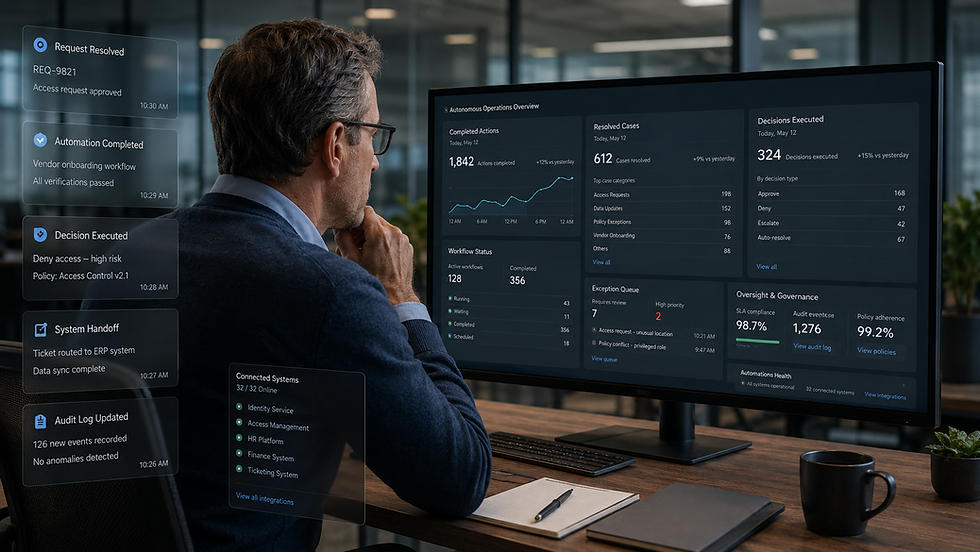
Autonomous agents don’t wait for commands. They observe conditions, detect opportunities or issues, and take action to achieve goals. These agents plan, coordinate, and even collaborate with other agents to optimise performance across your workflows.
Research from Info-Tech Research Group shows that 70% of organisations are embedding AI directly into IT operations, using it to coordinate workflows, identify issues, and reduce manual intervention. These environments are often the proving ground for wider agentic capability across the organisation.
At the more advanced end of AI-driven hyperautomation, organisations begin to combine agentic AI with low-code workflow orchestration and deep system integration. This allows workflows to span multiple tools and functions, responding to events in real time rather than executing isolated tasks.
The result is automation that can triage issues, enrich data, and take action autonomously. It moves beyond scripted execution toward coordinated, goal-driven behaviour, while keeping human oversight where judgment and accountability matter most.
By understanding your data and its implications, agentic AI can direct your systems and processes to avoid failures or achieve goals.
This is automation that it anticipates.
Just think, a system that identifies service disruption before it happens, reallocates resources, and notifies teams - all without intervention.
Other examples might include dynamic workforce scheduling, automated SLA recovery, or real-time supply chain rebalancing. This is the reality of agentic automation. This is an autonomy that doesn’t replace people but strengthens them, shifting human focus from operations to oversight, from control to creativity.
A Question of Trust
Of course, as automation grows more intelligent, the question shifts from “Can it do this?” to “Should it do this?”
So, as we develop our systems at each stage of maturity, this new functionality requires new forms of governance and transparency.
Our automated workflows must follow clear business rules.
AI assistants must be explainable, with decisions that can be traced and understood.
Autonomous systems must operate within defined ethical and operational boundaries.
Trust in these systems isn’t - and shouldn’t be - automatic; it’s designed. Building effective governance into the automation lifecycle will ensure organisations scale this intelligence responsibly, without losing accountability.
AI can make mistakes. We build systems to account for what we know and have experienced, but what if circumstances outside that occur? Validation of these systems is key.
We also know that AI systems often contain weights and biases in their understanding and processing, and have seen organisations develop problems with security; transparency is essential.
Evolving the Human Role
Providing positive employee experiences is our focus, creating environments that support a thriving workplace and satisfied customers. So, how does hyperautomation fit into this?
Hyperautomation isn’t about removing people; it’s about reevaluating the human role. As our systems grow more capable, humans move higher up the value chain, from providing process execution to problem-solving, oversight, and innovation.
With automation handling our routines, AI assistance making smarter decisions, and autonomy making our systems adaptive, the result isn’t a machine-led enterprise but a human-led organisation operating with confidence and control.
The Result - Scalable Intelligence
The path from automation to autonomy is both technological and cultural. It requires leaders to think beyond efficiency to develop ecosystems in which machines enhance our human capabilities, and intelligence grows with trust and governance.
Each step along the maturity path - automate, assist, agentic - builds on the last, creating operations that are not just faster but smarter.
The future of work isn’t about doing more with less; it’s about doing more with intelligence. If you’re thinking about where your organisation sits on the automation-to-autonomy spectrum, and considering what the next step looks like, let’s talk.
Defining how digital services and AI-enabled workflows operate, perform, and scale.